
Car Insurance Calculator: Estimate Your Car Insurance Cost


Calculate your customized car insurance rate
Car Insurance Coverage Calculator

We'll show you the average cost of our recommendation, or the cost of a policy you customize yourself.
First, let’s see what the minimum coverage requirements are in your state.


Car insurance estimates by company
American Family is the cheapest widely available car insurance company.
Erie and USAA tend to have even cheaper rates, but they're not available to everyone. Erie is only available in 11 states and Washington, D.C., and only drivers with ties to the military can buy insurance from USAA.
Full coverage car insurance estimates

Find Cheap Car Insurance Quotes in Your Area
Cheapest companies
Average companies
Most expensive companies
Companies | Monthly rate | ||
|---|---|---|---|
| Erie | $154 | ||
| American Family | $159 | ||
| Country Financial | $162 | ||
| NJM | $168 | ||
| Auto-Owners | $171 | ||
| Travelers | $173 | ||
| USAA | $125 | ||







USAA car insurance is only available to active-duty military members, veterans and the spouse or children of someone who has had a policy with USAA at some point.








Car insurance estimates are a good starting point when shopping for a new insurance policy. But your estimates will change depending on factors like your age, your driving record, where you live and the coverage you choose. And each company has its own way of calculating your rate.
How to estimate car insurance costs
If you want to estimate your car insurance costs before getting quotes, focus on the four top factors insurance companies use to calculate your rate:
- Start with your coverage level. Full coverage car insurance costs an average of $208 per month, while a minimum liability policy only costs around $76 per month.
- Factor in where you live. Where you live has a big impact on how much you pay for car insurance. For example, in Nevada, the most expensive state for car insurance, full coverage insurance costs $207 more per month than in the cheapest state, Vermont.
-
Adjust for your driving history and personal info. Certain details about you and your driving history significantly impact how much you'll pay for car insurance. This includes:
Younger, inexperienced drivers and people with bad driving records tend to pay more for car insurance.
- Your age
- Any prior tickets, accidents or DUIs
- How long you've had a driver's license
- Your credit score
- Your relationship status
- Consider the type of car you drive. New, expensive or fast cars typically cost more to insure than more affordable, safer models.
Calculate how much auto insurance you need
How much car insurance you need depends first on your state's minimum required coverage and how much protection you want.
The best car insurance coverage for you depends on your budget, your car's value and your state's requirements.
The most basic car insurance pays for damage you cause in an accident. You may also need to protect your own car with collision and comprehensive coverage if you have a car loan or lease. These coverages are also a good idea if you have a newer or expensive car.

Before deciding which insurance coverages to add, compare the cost of each type of coverage. Then, review your auto insurance estimates each year to find the cheapest rates and decide if you need different coverage.
Start with your state's minimum required insurance, then add higher coverage amounts and extra coverage options based on what you can afford or need. It doesn't cost much to add more liability coverage to your policy. It can also help you avoid a big bill if you cause a major crash.
Estimate the cost of different car insurance coverages
- What is it? Liability insurance pays for damage and injuries to other drivers after you cause an accident.
- Do you need it? Every state except New Hampshire requires liability insurance.
- How much should you have? State minimums usually aren't high enough to pay for the average accident. However, more coverage will raise your rates. You should get as much liability insurance as you can afford.
How much is bodily injury liability?
Limit per person | Limit per accident | Monthly cost |
|---|---|---|
| $25,000 | $50,000 | $43 |
| $50,000 | $100,000 | $51 |
| $100,000 | $300,000 | $58 |
| $250,000 | $500,000 | $71 |
How much is property damage liability?
Limit per accident | Monthly cost |
|---|---|
| $25,000 | $34 |
| $50,000 | $35 |
| $100,000 | $36 |
-
What is it? Collision coverage pays to fix your car after an accident with another vehicle or object, regardless of who's responsible.
Comprehensive coverage pays for other types of damage, like from hail or after hitting a deer.
- Do you need it? Yes, if you have a loan or lease. Also, consider this coverage if your car is worth more than $5,000 or you couldn't afford to replace it after a major crash.
- Which deductible should you choose? Pick an amount you could easily pay in an emergency.
How much is comprehensive and collision coverage?
Deductible | Collision | Comprehensive | Total |
|---|---|---|---|
| $250 | $99 | $48 | $147 |
| $500 | $84 | $40 | $124 |
| $1,000 | $67 | $33 | $100 |
- What is it? Uninsured or underinsured motorist coverage pays for your injuries or repairs if you're hit by a driver who doesn't have insurance or doesn't have limits high enough to pay your bills.
- Do you need it? In 20 states and Washington, D.C., drivers must have uninsured or underinsured motorist coverage. Even if your state doesn't require it, you should still consider getting it. It's affordable, and about 13% of drivers don't have car insurance.
- How much coverage should you have? The same limits as your liability coverage for bodily injury and property damage.
How much is uninsured and underinsured motorist bodily injury coverage?
Limit per person | Limit per accident | Monthly cost |
|---|---|---|
| $25,000 | $50,000 | $5 |
| $50,000 | $100,000 | $7 |
| $100,000 | $300,000 | $7 |
| $250,000 | $500,000 | $7 |
- What is it? Personal injury protection (PIP) covers drivers' and passengers' medical costs and lost wages after an accident, regardless of who's at fault.
- Do you need it? There are 16 states that require PIP. PIP is a good idea if your health insurance has high copays or deductibles. It's also smart to have PIP if you don't have an emergency fund to cover lost wages.
- How much should you have? Your state may require a minimum amount of PIP. Choose an amount you think would cover your medical bills after a major accident.
The minimum liability requirement may be enough to cover the costs of a minor accident. However, it probably won't be enough to replace the other driver's car or pay their medical bills after a major accident.
For example, state requirements for property damage liability coverage range from just $5,000 in Pennsylvania to $50,000 in North Carolina. But most states require between $20,000 and $25,000 of coverage.
The average cost of a brand-new car is just under $50,000. So if you hit and total a brand-new vehicle and have minimum coverage, you'll likely have to pay a large amount of money to help replace it.
Even if you cause an accident and the other driver has an older vehicle, minimum liability insurance could still leave you with a big bill. A three-year-old vehicle costs an average of $31,000 to replace, which is well above many states' required limits.
Look at average rates in your city to estimate car insurance costs
Car insurance rates vary by state, city and even ZIP code. This can be because of more road traffic, uninsured drivers or severe weather events. You'll also typically pay more if you live in a densely populated metro area because of higher accident and crime rates.
The best companies nationally may not have the cheapest car insurance near you. You should compare estimates from small and midsize companies in your area, along with major car insurance companies, to find the best rates.

Estimates for car insurance in your city and state
Start by choosing your state from the dropdown below. Then, search for average rates in your city to best estimate your car insurance rate.
Factor in your age, driving history, credit score and relationship status
Insurance companies use your age, accident history and credit score to determine your "riskiness" as a driver. Young drivers and people with a ticket or accident typically pay more for insurance than older drivers and drivers with clean driving records.
Younger drivers tend to pay more for car insurance. This is especially true for teens because young drivers have less experience behind the wheel and are more likely to cause a crash.
Your estimates will go down as you get older. But young drivers can save money by signing up for usage-based driving programs. These programs track your driving habits — including things like speed, hard braking and phone use — using an app or device that plugs into your car. By practicing safe driving habits, you could earn a sizable discount on your car insurance.
You'll almost always pay more for insurance after a ticket, a DUI or an accident.
The best way to find cheap rates after a ticket or accident is to compare estimates from multiple companies. Every company calculates rates differently, and some may raise your rates less after a ticket or an accident.
Drivers with poor credit pay more for car insurance in most states.
The best way to get cheaper rates is to improve your credit score. But that can take some time.
In the short term, try to find a company that offers lots of discounts you can easily qualify for. You can also consider a usage-based car insurance program if you typically practice safe driving habits.
Families with teen drivers typically have much higher car insurance estimates. You can find the cheapest family car insurance policy by shopping around for quotes from multiple companies.
In addition, married people often pay slightly less for car insurance than unmarried drivers.
Consider how your car affects your car insurance estimates
It's cheaper to insure cars that are older, slower or safer. That's because the insurance company likely won't have to pay as much money after an accident.
For example, full coverage insurance for a Toyota Rav-4 costs around $140 per month less than the same coverage for a Tesla Model Y. That's because Tesla's expensive technology can lead to costly repairs after a crash.
If your car insurance estimates are unaffordable, consider trading in your car for a vehicle that's cheaper to cover.
How can you get cheaper auto insurance estimates?
To find the most affordable insurance, get estimates from several companies. Also, look for discounts for bundling or automatic payments.
Compare estimates from multiple companies. Car insurance quotes can differ by up to $359 per month for full coverage from one company to the next. Get estimates from large insurance companies like American Family and Travelers and smaller ones like Erie and Auto-Owners.

Look for discounts. Most companies, especially large ones like Geico or Progressive, have a lot of discounts available. These discounts can add up to savings of 40% or more. And you may already qualify for many of them.
If you live with other drivers, consider a multicar policy. Adding another person to your insurance plan is cheaper than having two separate policies. You can share a multicar policy with anyone you live with.

Bundle with other insurance policies. Most major insurance companies offer the option to bundle your home or renters insurance with your auto insurance. Choosing a bundle deal can get you a discount on your total insurance cost for both policies.

Shop around every year. If your life situation or driving record has changed since you bought your policy, you may be able to get a cheaper rate. Improving your credit score, getting married or staying accident-free might help you save.
How to use ValuePenguin's car insurance calculator
Steps
- Choose your state from the dropdown.
- Review your state's minimum requirements to see what's required in your state if you want the cheapest possible policy.
- Select your net worth to see how much liability coverage we recommend to protect your personal finances. You'll be able to adjust your liability limits later.
- Answer a few questions about your car. Your car's value and whether you loan or lease will determine if it's worth it to get collision and comprehensive coverage.
- Get your average rate, personalized for a policy with the best coverage limits for you. You also have the option to adjust your coverage limits on this page, which can help you get a feel for how much protection you can afford.
Sample results
ValuePenguin car insurance calculator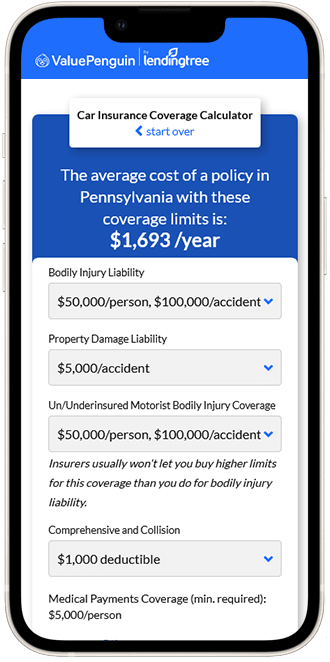
That's because insurance companies consider lots of factors to determine how much to charge for car insurance, including your age, credit score, driving history and the type of car you drive. They also factor in risks specific to your ZIP code, such as accident and crime rates and severe weather.
Additionally, our estimates don't include any discounts. Most car insurance companies offer at least a few discounts that are easy to get, such as a discount for signing up to get your bills via email or buying your policy online.
Frequently asked questions
How much should car insurance cost?
The average cost of car insurance in the United States is $208 per month for a full coverage policy. Minimum liability coverage typically costs around $76 per month. However, your rates will differ depending on where you live, your insurance company, what kind of car you have and your driving history.
How do I estimate car insurance costs?
The best way to estimate the cost of auto insurance is to use our online car insurance calculator. By answering three easy questions, you can estimate your car insurance rates based on your location, your car and how much coverage you need.
How much car insurance do I need?
At the very least, you need enough car insurance to meet the minimum legal requirements in your state. However, you should buy more coverage if you drive a lot, have a newer car or are paying off a car loan or lease.
What kind of car insurance should I get?
Nearly every state requires you to have liability insurance, which pays for injuries to other people and property damage. But it's worth it to pay more for full coverage if your car is worth more than $5,000 or less than eight years old. Higher limits and extra coverage can also help you avoid unexpected bills after a crash.
Methodology
ValuePenguin's car insurance calculator is based on millions of car insurance quotes from every ZIP code in the U.S., using multiple coverage limits. Rates are for a 30-year-old man with good credit and a good driving history who owns a 2015 Honda Civic EX.
National rates and rates by company are for a full coverage policy for a 30-year-old single man who owns a 2018 Honda Civic EX. Quotes include collision and comprehensive coverage, along with higher liability limits than the state requirement.
- Bodily injury liability: $50,000 per person and $100,000 per accident
- Property damage liability: $50,000 per accident
- Uninsured and underinsured motorist bodily injury: $50,000 per person and $100,000 per accident
- Collision and comprehensive deductible: $500
To calculate costs for each coverage type, our editors gathered quotes from ZIP codes across Illinois using the same driver profile above.
Insurance analysts and agents recommended matching a driver's net worth to their coverage. Estimates from our calculator default to higher coverage limits for higher-net-worth drivers.
To find the average cost to replace a car after an accident, ValuePenguin editors used new car data from Kelley Blue Book and used car data from Edmunds.
Rate data was compiled using Quadrant Information Services. Your quotes may differ, as these rates are averages and are best used only for comparative purposes.
About the Author

Senior Writer
Lindsay Bishop is a Senior Writer at ValuePenguin, where she educates readers about home, auto, renters, flood and motorcycle insurance.
Lindsay began her career in the insurance and financial industry in 2010. She was a licensed auto, home, life and health insurance agent and held Series 6 and 63 financial licenses.
After a hiatus from the financial sector, Lindsay returned to the industry as a content writer for ValuePenguin in 2021. She enjoys having the opportunity to help readers make smart decisions about their insurance so they can be prepared for anything life throws their way.
When Lindsay isn't writing about insurance, you can find her spending time with family, enjoying the outdoors on Sunday long runs or riding her Peloton.
How insurance helped Lindsay
As a homeowner for 15 years located in South Carolina, Lindsay has plenty of experience navigating the coastal insurance market and managing the claims process. That includes successfully negotiating a full roof replacement claim.
Expertise
- Home insurance
- Car insurance
- Flood insurance
- Renters insurance
- Motorcycle insurance
Referenced by
- CNBC
- Yahoo Finance
- Miami Herald
Education
- BS/BA Economics, University of Nevada Las Vegas
Editorial Note: The content of this article is based on the author's opinions and recommendations alone. It has not been previewed, commissioned or otherwise endorsed by any of our network partners.
